How crypto trading fees work: maker, taker and funding

Main takeaways
- Trading fee = order value × fee rate, charged when you open a position and again when you close it.
- Maker orders wait on the order book and usually pay less than taker orders, which fill at once.
- With leverage the fee is charged on the full position, so it takes a bigger share of your margin.
- Funding, the spread and withdrawal fees are separate costs. Only trading fees count towards cashback.
On this page
A crypto trading fee is what an exchange charges each time one of your orders fills. It is a percentage of the order value, the full size of the trade rather than your margin. The rate depends on the market (spot or futures), the order type (maker or taker) and your VIP level. This guide shows how the fee is worked out, and which other costs are often mistaken for it.
What are crypto trading fees?
An exchange charges a trading fee each time it matches your order with another trader's. It is deducted automatically, so it appears in your trade history rather than as a separate bill.
Rates are published by market and VIP level, and new accounts start at the standard level (VIP 0). The table shows the standard maker and taker rates on our five partner exchanges. Each fee guide has the full VIP table and the date we last checked it: Bybit, Binance, OKX, BloFin and Bitget.
| Exchange | Spot | Futures |
|---|---|---|
| Bybit | 0.1% / 0.1% | 0.02% / 0.055% |
| Binance | 0.1% / 0.1% | 0.02% / 0.05% |
| OKX | 0.08% / 0.1% | 0.02% / 0.05% |
| BloFin | 0.1% / 0.1% | 0.02% / 0.06% |
| Bitget | 0.1% / 0.1% | 0.02% / 0.06% |
Standard (non-VIP) rates as maker / taker, from each exchange's published fee schedule, checked on or after October 1, 2026. Your account shows the rates that apply to you.
How is a trading fee calculated?
Multiply the order value (quantity × price) by the fee rate.
Trading fee = Order value × Fee rate
Example: Trader A buys 0.2 BTC at 50,000 USDT with a market order, at an example taker rate of 0.1%.
Order value = 0.2 × 50,000 = 10,000 USDT
Trading fee = 10,000 × 0.1% = 10 USDT
Selling the BTC later is a second order with its own fee, so a round trip pays twice, whether the trade gains or loses.
With Commsback
Trader A gets 40% of the fee back: 4 of the 10 USDT. The purchase costs 6 USDT in fees, an effective rate of 0.06% instead of 0.1%.
Take note:
- Only the filled part of an order pays a fee. Cancelled and unfilled orders cost nothing.
- On a spot buy, many exchanges take the fee in the coin you receive, so you get slightly less than you ordered. USDT-margined futures charge it in USDT.
Maker vs taker fees
Every order is either a taker or a maker, depending on whether it fills straight away.
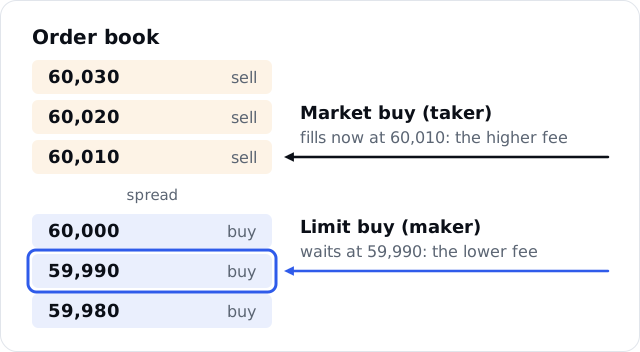
A taker order fills at once against orders already on the book: every market order, and any limit order priced to fill immediately, such as a buy limit above the lowest ask.
A maker order waits on the book until someone else fills it, such as a buy limit below the current price. It adds liquidity, so it pays a lower rate, and at high VIP levels some exchanges pay makers a small rebate instead.
- Market order: taker.
- Limit order that fills at once: taker.
- Limit order that waits, then fills: maker.
- Stop-loss and take-profit orders that trigger as market orders: taker.
Tip: Most exchanges, including Bybit and OKX, offer Post-Only for limit orders. An order that would fill at once is cancelled instead, so it can only ever fill as a maker.
Take note:
- A large limit order can be both: the part that matches at once pays the taker rate, and the rest pays the maker rate when it fills.
How leverage affects trading fees
On futures the fee is charged on the position value, not on your margin. Leverage makes the position larger than the margin, so the same rate takes a bigger share of the money you put in.
Position value = Margin × Leverage
Example: Trader A opens a 10× long on BTC/USDT with 1,000 USDT of margin, using market orders. The position value is 10,000 USDT, and the example taker rate is 0.05%.
Opening fee = 10,000 × 0.05% = 5 USDT
Closing fee = 10,000 × 0.05% = 5 USDT
Round trip = 10 USDT, or 1% of the margin
Trader B makes the same trade with limit orders that fill as maker orders, at an example 0.02%: 2 USDT to open and 2 USDT to close, 4 USDT in total.
Over 100 round trips like this in a month, Trader A pays 1,000 USDT in fees, as much as the whole margin.
With Commsback
Trader A gets 40% of the fees back: 4 USDT per round trip, or 400 USDT over the month's 100 round trips. On the 1,000 USDT margin, the month's return rises from +50% to +90%.
| Trader A's month | Without Commsback | With Commsback |
|---|---|---|
| Result before fees | +1,500 USDT | +1,500 USDT |
| Fees | −1,000 USDT | −1,000 USDT |
| Cashback | 0 USDT | +400 USDT |
| Result | +500 USDT | +900 USDT |
| Return on margin | +50% | +90% |
A losing month works the same way: −500 USDT before fees becomes −1,500 USDT after them (−150% of the margin), or −1,100 USDT (−110%) with Commsback.
Cashback is worked out on net fees, after the exchange's own deductions, so the real figure can be slightly lower. Try your own volume in the fee calculator.
Take note:
- The closing fee uses the closing price, so it differs slightly from the opening fee if the price has moved.
- Leverage doesn't change the rate, only the position value it applies to.
Spot vs futures fees
Spot means buying and selling the coin itself. Spot rates are usually higher, but spot trades rarely use leverage, so the order value is no bigger than the money you spend.
Futures rates are lower, with a wider gap between maker and taker. Because leverage multiplies the position value, an active futures trader often pays more in total despite the lower rate. Our fee comparison prices the same futures trade on each partner exchange.
VIP levels and fee discounts
Rates fall at higher VIP levels, which are usually set by your 30-day trading volume, and on some exchanges by the assets you hold. The thresholds differ by exchange, and our fee guides list them.
Some exchanges also discount fees paid in their own token, such as BNB on Binance or MNT on Bybit. The size of the discount and the markets it covers vary. Our guide to the 6 ways to pay less in trading fees covers each option.
Costs that are not trading fees
These appear in your account history next to trading fees, but they are charged differently and don't count towards cashback.
- Funding: on perpetual futures, longs and shorts pay each other at set times, usually every 8 hours. When the rate is positive longs pay shorts, and when it is negative shorts pay longs. The money goes to other traders, not the exchange.
- The spread: the gap between the best buy and sell prices. A market order fills on the far side of it, and on thin markets that can cost more than the fee.
- Withdrawal and network fees: sending crypto off the exchange costs a network fee that depends on the coin and network.
- Borrowing interest: margin trading on spot charges interest while the loan is open.
How can I pay less in trading fees?
Use maker orders where you can, make fewer round trips, reach a higher VIP level, pay with a fee token where it gives a discount, and get fee cashback.
Cashback is the only one that needs no change to how you trade. With Commsback you get 40% of your trading fees back, paid daily in USDT to your exchange account, from the UTC day you activate your UID. What is Commsback? explains how it is worked out.