Crypto trading fee cashback: how it works and is it safe?

Main takeaways
- Fee cashback comes from the exchange's official partner programme, and your fee rates stay the same.
- It is allowed: signing up through a partner's link is what the programme is for.
- A safe service needs only your UID. Never share your password, 2FA codes or API keys, and never send crypto first.
On this page
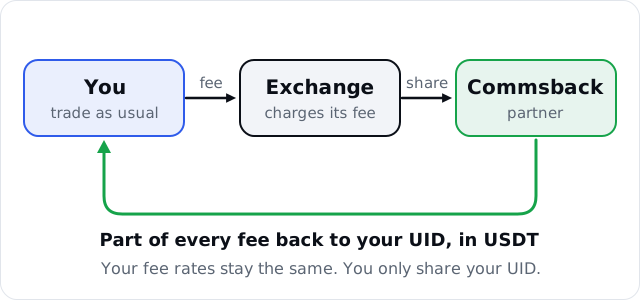
Trading fee cashback, also called a fee rebate, gives you back part of the trading fees you pay on a crypto exchange. It comes from the exchange's official partner programme: the exchange shares part of your fees with the partner whose link you signed up with, and the partner passes part of that back to you. Your fee rates stay the same.
Where does the cashback come from?
Bybit, Binance, OKX, BloFin and Bitget all run partner (affiliate) programmes. When a trader signs up through a partner's link, the exchange pays the partner a share of that trader's fees as a referral commission.
A cashback service is a partner that passes part of that commission back to the trader. Commsback sends you 40% of your fees, daily, in USDT, and keeps a small part to run the service.
With Commsback
A trader who pays 1,000 USDT a month in fees gets 400 USDT a month back, or 4,800 USDT a year, from the same trades.
Cashback, rebate or referral code: what is the difference?
Fee cashback and fee rebate are two names for the same thing: part of the trading fee you already paid, sent back to you afterwards. You will also see it called a fee refund or a kickback.
A referral code is different. It decides which partner the exchange links your account to, and some referrers share part of their commission with the people they invite, as a lower fee rate or a sign-up bonus. What you get depends on the referrer and on the exchange's rules. Fee cashback is paid on every trade, for as long as the account trades. Referral code or cashback compares the two.
Neither is card cashback. The rewards an exchange's payment card pays on shopping are a separate programme; fee cashback is only about trading fees.
Is fee cashback allowed?
Yes. Signing up through a partner's link is what the partner programme is for, and the exchange chooses to share the fee. What exchanges forbid is self-referral: referring your own extra accounts to yourself. Using a cashback service with your one account is not self-referral.
How to tell a safe cashback service from an unsafe one
A cashback service only needs to know which account to pay: your UID. A UID can receive money, but it can't be used to log in or withdraw.
- Safe: asks only for your UID, and pays into your exchange account.
- Red flag: asks for your password, 2FA codes or email login.
- Red flag: asks for API keys, especially keys with trading or withdrawal permission.
- Red flag: asks you to deposit or send crypto to them first.
- Red flag: promises trading profits. Cashback lowers your costs; whether a trade gains is up to the market.
What to compare between cashback services
- The rate, and what it is a percentage of. Commsback pays 40% of your net fees: what you paid minus the costs the exchange deducts before paying partners, such as bonuses and coupons you used.
- How often you are paid. Commsback pays every day once your UID is on the payout list and your balance reaches the minimum.
- How you are paid. Commsback pays USDT straight to your exchange account, so you don't need a separate wallet.
- What they ask for. Only your UID should be needed.
- Whether the rate is what you actually get, or only "up to" a figure most people never reach.
How much does fee cashback come to?
It follows the fees you pay, and those depend on your trading volume, how many of your orders are takers and your VIP level. Futures traders pay the most, because the fee is charged on the whole position, leverage included, so cashback matters most to them. How trading fees work explains the calculation.
The fee calculator works it out from your own monthly volume on each exchange. To lower the fee itself as well, see the 6 ways to pay less in trading fees.
Fee cashback on each exchange
Commsback works with five exchanges. Each has a page on how its cashback is set up and what its fees come to after cashback, and a fee guide with its published rates. Not sure which one suits you? How to choose an exchange for cashback goes through it.
- Bybit cashback: activated with your UID on this site, and paid daily. Bybit trading fees.
- Binance cashback: set up with our team on Live Chat. Binance trading fees.
- OKX cashback: set up with our team on Live Chat. OKX trading fees.
- BloFin cashback: set up with our team on Live Chat. BloFin trading fees.
- Bitget cashback: set up with our team on Live Chat. Bitget trading fees.
Can I get cashback on an account I already have?
Only accounts opened through a partner's link qualify, because the partner is fixed when the account is created.
On Bybit you don't have to give up your verification: open a new account through our link, activate its UID, then move your verification to it from your current account (Identity Verification → Verify Now → Identity Transfer). Still having issues? Chat with us.
How do I start getting fee cashback?
- Choose your exchange on Commsback and click "Sign up on [exchange]". For Bybit, its sign-up page opens in a new tab through our partner link; for the other exchanges, the button takes you to Live Chat.
- Open your account there, then copy your UID from your profile.
- Paste the UID on Commsback and click "Activate cashback" the same day. Cashback counts from that UTC day; fees from earlier days aren't covered.