Fee cashback for active crypto traders
Main takeaways
- Trading fees scale with turnover and leverage, not account size, so a small account can pay thousands a year.
- A round trip must move about twice the fee rate before a trade breaks even.
- Fee cashback lowers your effective fee rate on every trade without changing how you trade.
- Never trade more or raise leverage for cashback: you always pay more than comes back.
On this page
Active traders pay the most in fees because fees scale with turnover, not account size: every open and every close is charged on the full position value. Fee cashback returns a share of each of those fees, which lowers the move a trade needs to break even.
Why do active traders pay so much in fees?
Your fee bill depends on how much you trade and the rate you pay. A trader who turns over a $5,000 account ten times a day pays far more than one who buys $100,000 of bitcoin and holds it.
Each fee is small and taken quietly from your balance. Over a month of active trading, fees are often one of your largest costs, sometimes larger than your net result.
How does leverage multiply your fee bill?
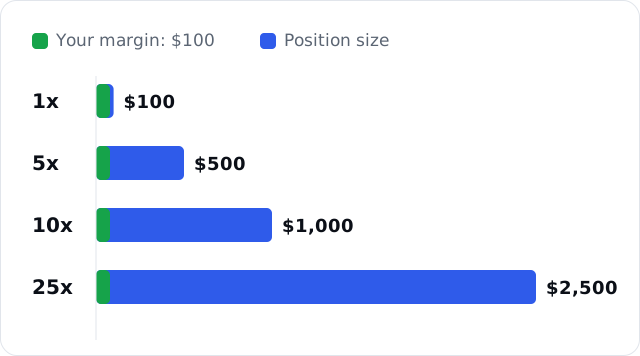
On futures, the fee is charged on the position value, not your margin. Leverage doesn't change the rate, but it makes the position bigger. The table uses $2,000 of margin and an example 0.05% taker fee to open and again to close, not any exchange's real rate.
| Leverage | Position value | Round-trip fees | Fees as % of margin |
|---|---|---|---|
| 1× | $2,000 | $2 | 0.1% |
| 5× | $10,000 | $10 | 0.5% |
| 10× | $20,000 | $20 | 1% |
| 20× | $40,000 | $40 | 2% |
How do fees move your break-even point?
You pay to open and again to close, so the price must move in your favour by roughly twice the fee rate before a trade makes anything. At the example 0.05%, that is 0.1%, before slippage and funding.
For a swing trader aiming at 3%, that hurdle is small. For a scalper aiming at 0.3%, it is a third of the target, which is why fees decide whether many short-term strategies work at all. Our article on fee awareness shows the effect on the win rate you need.
Scalpers vs swing traders: who gains more?
Both pay fees on every trade, but fees play a very different role.
| Scalper | Swing trader | |
|---|---|---|
| Trades per month | Hundreds or more | A handful to a few dozen |
| Fees as a share of the target | Large | Small |
| Biggest cost to watch | Taker fees and slippage | Funding on positions held for days |
| What cashback returns | A share of a large fee bill | A share of a smaller bill |
How to cut costs without trading more
- Use maker orders where your strategy allows. The maker and taker gap repeats on every trade: see how trading fees work.
- Climb VIP levels only if your normal volume gets you there. Cashback applies on top of your VIP rate.
- Track funding separately, since cashback doesn't apply to it. Tracking your fees shows how.
- Check your effective fee rate after cashback once a month.
What is cashback worth on an active trader's fees?
Take the 10× row and five round trips a day on 20 days a month. That is 100 round trips at $20: $2,000 in fees a month on a $2,000 account. With cashback, about 40% of that $2,000 comes back every month. The numbers are illustrative; the fee calculator uses your own volume.
Commsback sends 40% of your net fees back, paid daily in USDT on Bybit, each payout covering the previous day's trading. It needs only your UID, it is free, and you keep the exchange's sign-up rewards. On Binance, OKX, BloFin and Bitget, our team sets it up on Live Chat.
Cashback won't make a losing strategy win, but it makes a working one cheaper to run, and it counts from the UTC day you activate. Get started before your next session.
Questions people ask
Does fee cashback work at VIP levels?
Yes. Cashback is a share of the fees you actually pay, so it applies on top of any VIP rate. Maker rebates the exchange pays you aren't fees, so nothing comes back on them.
Do I get more cashback with higher leverage?
Your fees grow with position size, so the cashback does too. But leverage raises your liquidation risk and your fee bill. Never raise it for cashback: you always pay more than comes back.
Is cashback paid on funding fees?
No. Funding is paid between long and short traders, not to the exchange, so it isn't a trading fee.