Fee awareness: the trading cost you can control

Main takeaways
- In a tight illustrative setup, round-trip fees lift the break-even win rate from about 33% to about 44%.
- Maker orders, fewer trades and watching funding cut costs without changing your market view.
- Funding isn't a trading fee, so track it on its own line.
- Fee cashback is the one cost lever that needs no change in how you trade.
On this page
You can't control where the price goes, but you can control what each trade costs. Traders who know their fees make different decisions: they see how fees raise the win rate they need, use maker orders, trade less and watch funding.
Why does knowing your fees change your decisions?
Many traders track their entries and stops closely but don't know what they paid in fees last month. The fee appears in small print after each fill and leaves your balance without a prompt.
Once you put a number on it, usually by tracking your fees monthly, it starts to shape choices: which order type to use, whether a trade is worth taking, how long to hold.
How do fees change the win rate you need?
Fees shrink every win and enlarge every loss. Take a futures trade with a 0.6% target and a 0.3% stop, paying an example 0.05% taker fee to open and again to close. On paper it needs to win one trade in three; after fees, closer to four in nine.
| Before fees | After round-trip fees | |
|---|---|---|
| Gain if the target is hit | 0.6% | 0.5% |
| Loss if the stop is hit | 0.3% | 0.4% |
| Reward to risk | 2 to 1 | 1.25 to 1 |
| Win rate needed to break even | About 33% | About 44% |
Which maker and taker habits cost you most?
The tighter your targets, the more the order type matters. How trading fees work explains which orders pay which fee.
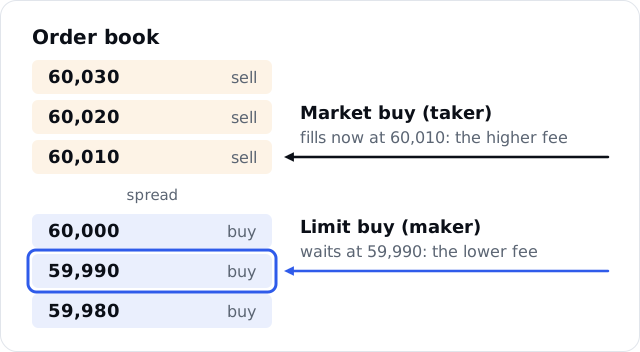
- Entering with market orders out of impatience. A post-only limit order pays the maker fee or doesn't fill.
- Chasing a move with a limit priced through the book. It fills at once and pays the taker fee.
- Taking profit with market orders. A resting limit order can often fill as a maker.
- Forgetting that stop-market orders pay the taker fee. That is the right trade-off for protection, but count it.
Three more costs to watch
- Overtrading. Every trade pays the round trip, win or lose. If fees are a large share of your result before fees, cut the weakest trades first.
- Funding. On perpetual futures it is paid between longs and shorts, and over a few days it can exceed your trading fees. Cashback doesn't touch it.
- VIP levels. If your normal volume is close to the next level, check the threshold in the fee guides for Bybit and the others. Never trade extra just to reach one.
Where does fee cashback fit?
Fee cashback is the one lever that needs no change in how you trade. It is a share of whatever fees you actually pay, so it sits on top of maker orders and VIP rates and lowers your effective rate, narrowing the gap in the table above. If you pay $200 of fees a month, about 40% of $200 comes back each month.
With Commsback you get 40% of your net fees back, paid daily in USDT on Bybit, from the UTC day you activate. It needs only your UID, it is free, and you keep the exchange's sign-up rewards. For Binance, OKX, BloFin and Bitget, our team sets it up on Live Chat. Our article on cashback for active traders shows how the saving grows with leverage.
It doesn't cover losses, and it is never a reason to trade more. It lowers the cost of the trades you already take. Get started.
Questions people ask
Is fee awareness a trading strategy?
No. It doesn't tell you what or when to trade. It makes sure the costs of your existing strategy are known and kept as low as they can be.
Should I always use limit orders?
Not always. Speed sometimes matters more than the fee, and stop-losses should fill when they trigger. Use maker orders where waiting costs you nothing.
Does cashback change my break-even win rate?
Slightly. By returning part of each fee it lowers your effective fee rate. Try your own volume in the fee calculator.