Futures vs spot trading: which suits you?

Main takeaways
- Spot means owning the coin; futures means holding a contract on its price, with leverage and the option to short.
- A spot holding can wait out a fall, while a leveraged futures position can be liquidated after a much smaller move.
- Futures fee rates are often lower, but they apply to the full leveraged position, so you usually pay more in dollars.
- Most beginners do better learning on spot before adding leverage.
On this page
Spot trading means buying the coin itself: you pay in full, you own it and you can withdraw it. Futures trading means trading contracts on the price, with leverage and shorting, and the risk that a position is liquidated.
What is the difference between spot and futures?
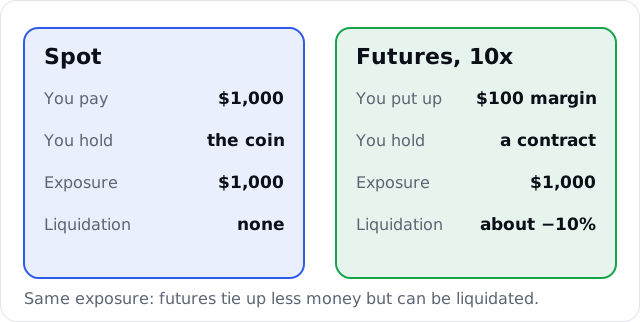
Buy $1,000 of a coin on spot and let it fall 10%: your holding is worth $900, and nothing forces you to sell. The worst case is the coin going to zero.
In futures, $100 of margin at 10x controls a $1,000 position. A 10% rise doubles your margin; a fall of a little under 10% liquidates the position and the $100 is gone. Unlike a spot holding, the position can't wait for the price to recover. The basics are in what is crypto futures trading.
How do spot and futures compare?
| Spot | Futures | |
|---|---|---|
| You own the coin | Yes | No, you hold a contract |
| Withdraw to a wallet | Yes | No |
| Leverage | None on a plain spot trade | Yes, set per position |
| Profit when price falls | Only by selling first | Yes, by going short |
| Worst case | Coin falls to zero | Margin lost after a smaller move |
| Holding cost | None | Funding, paid or received |
| Fees charged on | The amount you trade | The full leveraged position |
Which is riskier, futures or spot?
Futures, for most people. Spot has market risk: prices fall. Futures add leverage and liquidation, so a position can be closed at a loss in minutes even if the price recovers an hour later.
Leverage is optional. At 1x or 2x the liquidation price sits far away and futures behave more like spot, though you still pay funding and don't own the coin. How leverage works shows how fast the risk grows as leverage rises.
Who is each market for?
Many traders use both: a core holding on spot and a fixed, smaller budget for futures, so a bad futures run never reaches the coins they meant to keep. As a rough guide:
- Spot suits long-term holders and anyone who wants to withdraw their coins.
- Spot suits beginners: you learn orders, fees and volatility without liquidation risk.
- Futures suit experienced traders who trade short-term moves in both directions with set stop losses.
- Futures suit holders who want to hedge: a short can offset a fall in coins kept on spot.
- Futures don't suit anyone who can't afford to lose their whole margin.
Which costs more in fees?
Both markets charge a fee when you buy and when you sell. With round example rates, a $1,000 spot buy at 0.1% costs $1. The same $1,000 used as margin at 10x controls $10,000 of futures; at an example 0.05% taker fee, opening and closing it costs about $10, ten times as much on the same money.
Perpetual futures add funding while you hold, which is separate from fees and passes between traders. Real rates for each exchange are in our exchange fee comparison.
Whichever market you choose, Commsback sends 40% of your trading fees back, on spot and futures alike: $200 of fees a month means about 40% of $200 back. On Bybit it is paid daily in USDT, you share only your UID, and it is free. It lowers your trading costs; it doesn't reduce your risk. Get started.
Questions people ask
Is futures trading better than spot trading?
Neither is better in general. Spot is simpler and lets you own the coin with no liquidation risk. Futures offer leverage, shorting and hedging, at the price of much higher risk and extra costs such as funding.
Can I short crypto on spot?
Not with a plain spot trade. You can sell coins you hold, or borrow coins through a margin account. Futures are the usual way to short: see long vs short in crypto futures.
Should a beginner start with futures or spot?
Spot. Learn how orders, fees and price swings feel with money you can afford to lose before adding leverage. If you later try futures, start small and with low leverage.