Long vs short in crypto futures: trading both ways

Main takeaways
- A long gains when the price rises and a short gains when it falls. In futures, each takes a single order.
- You can short a coin in futures without owning or borrowing it.
- A long's loss stops when the price reaches zero; a short's keeps growing as the price climbs.
- Trading fees are the same in both directions, while funding is paid by one side to the other.
On this page
Going long means opening a position that gains when the price rises; going short means opening one that gains when it falls. In crypto futures both take a single order, but shorts face sharp rallies and squeezes, so they need tight risk control. If futures are new to you, start with what crypto futures trading is.
What do long and short mean?
A long is a bet the price will rise. You open it with a buy order and close it with a sell order of the same size. It works like buying the coin, except you don't own it and leverage can make the position larger than your margin.
A short is a bet the price will fall. You open it with a sell order, holding no coins, and close it later with a buy order. On spot, shorting means borrowing coins and paying interest; futures remove that step, which is why they are the usual way to short. A short can also hedge coins you hold: see futures vs spot trading.
How do long and short trades work out?
Take Ether at $3,000. You put down $300 of margin at 5x, a $1,500 position. Fees and funding are left out to keep the numbers clear.
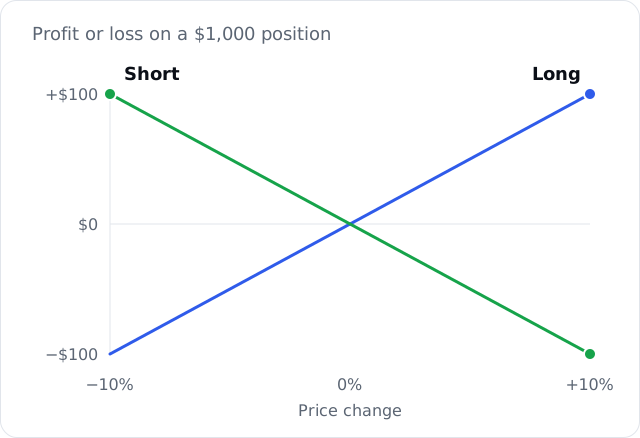
- Long, price rises 10% to $3,300: you gain $150, half your margin.
- Long, price falls 10% to $2,700: you lose $150.
- Short, price falls 10% to $2,700: you gain $150.
- Short, price rises 10% to $3,300: you lose $150.
- Either side, a move of about 20% against you: at 5x the position is close to liquidation and the $300 is nearly gone.
How do long and short positions compare?
Liquidation caps the loss on an isolated position at its margin, whichever side you are on. But a price can rise much further than it can fall, so sharp moves up hit shorts hardest.
| Long | Short | |
|---|---|---|
| You profit when | Price rises | Price falls |
| Opened with | Buy order | Sell order |
| Price risk in theory | Limited: price stops at zero | Unlimited: price can keep rising |
| Positive funding rate | You pay | You receive |
| Negative funding rate | You receive | You pay |
What are the risks of shorting crypto?
- Short squeezes: a rise forces shorts to buy back, which pushes the price higher and triggers more stops and liquidations.
- Fast rallies: news or a large buyer can take a short from comfortable to liquidated in minutes.
- Funding: when the market leans short, the rate can turn negative and shorts pay longs at every settlement.
- Small coins: they can double in a day, which no short survives without a stop loss.
What do longs and shorts pay in fees and funding?
Trading fees are the same in both directions: the maker or taker rate on the full position, once to open and once to close. A strategy that flips between long and short pays them on every flip, so check how trading fees work.
Funding is separate. It passes between the two sides, not to the exchange. With an illustrative positive rate of 0.01% every 8 hours, a $10,000 long pays $1 a settlement and a $10,000 short receives it. Perpetual futures explained covers how the rate is set.
Commsback sends 40% of your trading fees back, on longs and shorts alike: $200 of fees a month means about 40% of $200 back. On Bybit it is paid daily in USDT, you share only your UID, it is free, and you keep Bybit's sign-up rewards. It doesn't change whether a trade wins or loses. Get started.
Questions people ask
Do I need to own a coin to short it in futures?
No. A futures short is opened with a sell order using margin, without owning or borrowing the coin.
Which side pays funding?
When the funding rate is positive, longs pay shorts. When it is negative, shorts pay longs. Rates and intervals vary by exchange and contract.
Can you hold a long and a short at the same time?
Only in hedge mode, which some exchanges offer. In one-way mode a sell order reduces your long instead. Holding both rarely makes sense for beginners: you pay fees on both while they cancel out. Futures order types covers reduce-only exits.