What is crypto futures trading? A beginner's guide

Main takeaways
- Crypto futures are contracts that follow a coin's price: you never own the coin, and you can profit or lose in either direction.
- Leverage lets a small margin control a large position, so losses grow as fast as gains and can end in liquidation.
- Most crypto futures are perpetual contracts with no expiry, kept close to the spot price by funding payments between traders.
- Trading fees are charged on the full position size, not your margin, so they add up quickly for active traders.
On this page
Crypto futures trading means buying or selling contracts that track a coin's price instead of the coin itself. You put down margin, can use leverage and can profit or lose whether the price rises or falls, which makes futures faster and riskier than buying crypto.
How do crypto futures work?
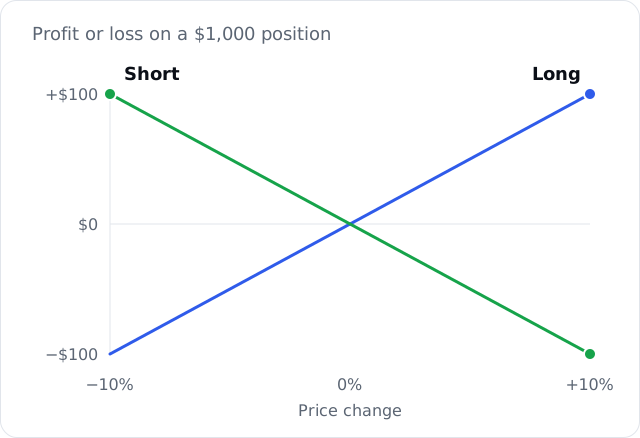
A futures contract follows the price of an asset such as Bitcoin. Buy (go long) and you gain when the price rises; sell (go short) and you gain when it falls. The exchange matches you with a trader on the other side.
You never receive the coin. Most contracts are USDT-margined, so margin, profit and loss are all in USDT. A $1,000 long on Bitcoin gains $50 if the price rises 5% and loses $50 if it falls 5%, before fees. Both directions are covered in long vs short in crypto futures.
How are futures different from buying crypto?
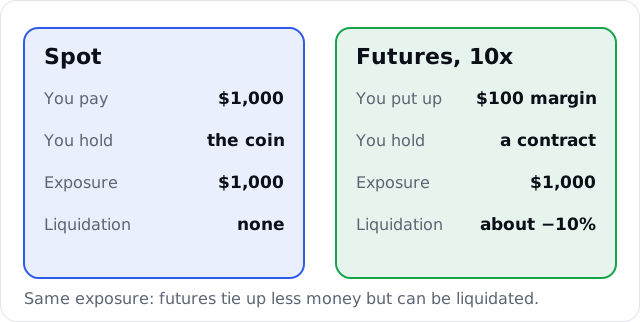
On the spot market you buy the coin and can wait out a fall. In futures you hold a position that the exchange can close for you if losses use up its margin. The full comparison is in futures vs spot trading.
| Spot | Futures | |
|---|---|---|
| You own the coin | Yes | No, you hold a contract |
| Leverage | No | Yes, set per position |
| Profit when price falls | No | Yes, by going short |
| Can be closed for you | No | Yes, by liquidation |
| Holding cost | None | Funding on perpetuals |
What are perpetual and dated futures?
Dated futures expire on a set day and settle at a reference price. Perpetual futures never expire, so exchanges keep their price close to spot with a funding rate: a small payment between longs and shorts every few hours.
Perpetuals hold most crypto futures volume because there is nothing to roll over. Perpetual futures explained covers funding and the mark price.
What are margin, leverage and liquidation?
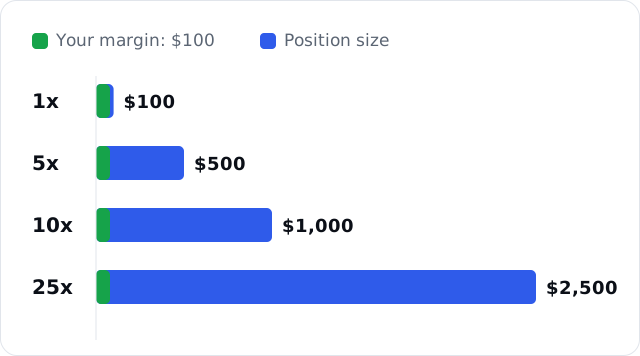
Margin is the money you set aside for a position. Leverage is the position size divided by that margin: $100 at 10x controls a $1,000 position, so a 1% price move changes your margin by 10%.
If losses bring your margin down to the maintenance level, the exchange closes the position. That is liquidation, and the margin is gone. The higher your leverage, the closer the liquidation price sits to your entry: see how leverage works. Margin, liquidation and funding goes through each in turn.
Is futures trading right for you?
Leveraged trading is hard. Brokers in the UK and EU must publish how many retail clients lose money on leveraged contracts, and it is usually well over half. Crypto futures carry the same risk in a more volatile market. Before you start:
- Only trade money you can afford to lose completely.
- Start with low leverage and small positions.
- Set a stop loss before you enter, not after: futures order types shows how.
- Know the common futures trading mistakes before you make them.
- Check that crypto derivatives are allowed where you live.
- Read futures risk management before you trade real money.
What do futures fees cost you?
You pay a trading fee to open a position and again to close it, charged on the full position size. Take an illustrative 0.05% taker fee: a $1,000 position at 10x costs about $0.50 each way, so every round trip takes 1% of a $100 margin. Funding is separate: it passes between traders, not to the exchange.
Trade every day and those fees become one of your biggest costs. Commsback sends 40% of your trading fees back, so $200 of fees a month means about 40% of $200 back. On Bybit it is paid daily in USDT, you share only your UID, it is free, and you keep Bybit's own sign-up rewards.
Cashback lowers your costs; it doesn't make a losing trade profitable. Get started or see the Bybit cashback page.
Questions people ask
Can you lose more than you put in with crypto futures?
On major exchanges, an isolated position's loss is normally limited to its margin, because the exchange liquidates it first. In cross margin your whole balance can back a position: see isolated vs cross margin.
Do I own Bitcoin when I trade Bitcoin futures?
No. You hold a contract that follows Bitcoin's price and settles in its margin currency, usually USDT. You can't withdraw it to a wallet.
Are futures fees higher than spot fees?
Futures rates are often lower per dollar traded, but leverage makes positions larger, so you usually pay more in dollars. Compare rates in our exchange fee comparison.