Isolated vs cross margin: which should you use?

Main takeaways
- Isolated margin caps a position's loss at the margin you assign to it; the rest of your balance is untouched.
- Cross margin backs positions with your whole balance, so liquidation is further away but can take most of the account.
- A stop loss decides your exit in both modes; margin mode is the safety net if the stop fails.
- Margin mode doesn't change fees: you pay the same rate on the full position either way.
On this page
Isolated margin limits each futures position to the margin you assign to it; cross margin lets every position draw on your whole balance. Isolated suits beginners and single trades, while cross suits experienced traders managing several positions together. If futures are new to you, start with what crypto futures trading is.
What is isolated margin?
In isolated margin each position has its own pot of margin, set by the leverage you choose. Losses come only out of that pot. If the position is liquidated, only that margin is lost.
You can add margin to an isolated position by hand to move its liquidation price away, but nothing is added automatically. How much margin a position needs depends on your leverage: see how leverage works.
What is cross margin?
In cross margin your available balance is shared. Every open position can draw on it, and unrealised profit on one position can support another. That puts liquidation further away for any single position.
The drawback is that when a cross position is liquidated, the loss isn't limited to what you first put in and can take most of your balance. Unified or portfolio margin accounts go further and count coins you hold as collateral, usually at a discount, so a fall in those coins shrinks your margin too.
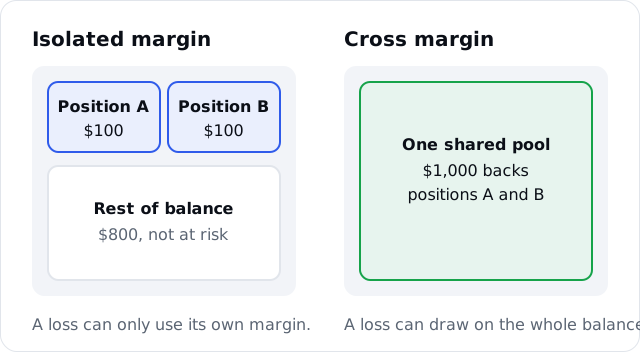
Isolated vs cross margin: a worked example
You have $2,000 in your futures account and open a $10,000 Bitcoin long. Assume a maintenance margin of 0.5% ($50) and leave fees aside; the numbers are illustrative.
| Isolated, $1,000 at 10x | Cross, $2,000 behind it | |
|---|---|---|
| Liquidated after a fall of about | 9.5% | 19.5% |
| Loss if liquidated | About $1,000 | About $2,000 |
| Balance left afterwards | About $1,000 | Close to nothing |
| Loss with a stop 5% below entry | About $500 | About $500 |
When should you use each mode?
The last row of the example matters most. With a stop loss well before liquidation, both modes lose the same, because the stop decides your exit. Margin mode is the safety net for when the plan fails: a gap through your stop, a stop you forgot, an exchange outage.
- Isolated suits beginners: the most you can lose on a trade is visible before you open it.
- Isolated suits speculative trades on volatile coins, where a spike could otherwise reach your whole account.
- Cross suits experienced traders running offsetting positions who watch the account as a whole.
- Cross suits hedges, where a futures short offsets a spot holding and an early liquidation would break the hedge.
What are the risks of each mode?
Isolated positions are liquidated sooner, and topping up a losing trade again and again turns a capped loss into an open-ended one.
Cross margin's risks are quieter. One bad position can drag down the others, a loss elsewhere can move a liquidation price without you touching it, and a distant liquidation tempts you into larger positions. Keep only money you mean to trade in a cross account. Futures risk management covers stops and sizing.
Does margin mode change your fees?
No. You pay the same maker or taker rate on the full position size in either mode. With an illustrative 0.05% taker fee, the $10,000 position above costs about $10 to open and close, whether $1,000 or $2,000 stands behind it. What raises fees is position size, and cross margin makes larger positions easy to open.
Commsback sends 40% of your trading fees back on accounts opened through our link: $200 of fees a month means about 40% of $200 back. On Bybit it is paid daily in USDT, you share only your UID, it is free, and you keep Bybit's sign-up rewards. It lowers costs; it doesn't reduce risk. Get started or see the Bybit cashback page.
Questions people ask
Is isolated or cross margin better for beginners?
Isolated is usually the better start, because each trade's maximum loss is the margin you assign to it. Combine it with low leverage and a stop loss.
Can I switch between isolated and cross margin?
Most exchanges let you choose per contract, but many allow a change only when you have no open position or orders on that contract.
Does cross margin mean I can't be liquidated?
No. It moves liquidation further away by using your whole balance, but if losses use that up, the position is liquidated and most of the balance is gone. Margin, liquidation and funding explains how.