Margin, liquidation and funding in crypto futures

Main takeaways
- Initial margin is the position size divided by leverage; maintenance margin is the minimum a position must keep.
- When margin falls to the maintenance level, the exchange liquidates the position and its margin is lost.
- Funding passes between longs and shorts every few hours; unlike trading fees, it doesn't go to the exchange.
- A stop loss well before the liquidation price costs far less than letting the exchange close you out.
On this page
Initial margin is what you put down to open a futures position, and maintenance margin is the minimum it must keep. If losses take it down to that level, the exchange liquidates the position; on perpetuals, funding adds to or takes from your balance every few hours. If futures are new to you, start with what crypto futures trading is.
What are initial and maintenance margin?
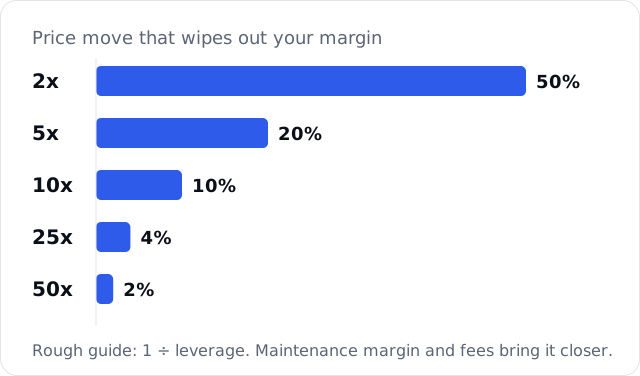
Initial margin is the position size divided by your leverage: a $5,000 position needs $500 at 10x or $1,000 at 5x. Lower leverage means more margin and a liquidation price further away: see how leverage works.
Maintenance margin is the buffer a position must keep, usually a small percentage of its size. It rises in steps for larger positions and for smaller, more volatile coins. Each exchange publishes its tiers on the contract details page.
What happens when a position is liquidated?
The exchange checks your margin against the mark price, a fair-value price from several spot markets. When the margin falls to the maintenance level, the liquidation engine takes over and closes the position. The margin assigned to it is lost, and some exchanges charge a liquidation fee on top.
Any margin left after the close usually goes to the exchange's insurance fund, which also covers closes that happen past the point where your margin hits zero. That is why retail traders on major exchanges normally can't lose more than a position's margin. In extreme markets, some exchanges also close part of profitable traders' positions on the other side, called auto-deleveraging.
How does funding affect your margin?
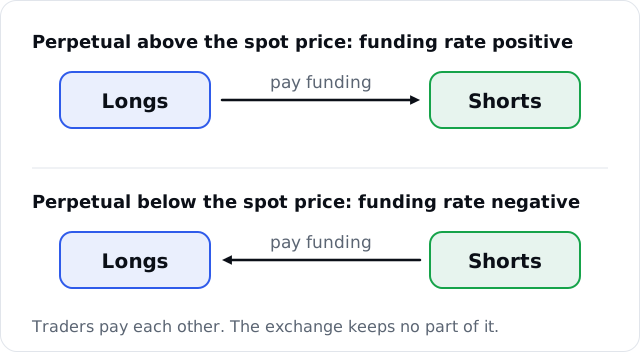
On perpetuals, funding passes between longs and shorts at set times, often every 8 hours. A positive rate means longs pay shorts; a negative rate, the reverse. You pay or receive the position value times the rate, only if you hold a position at that moment.
Funding is added to or taken from your balance, and paying it can nudge the liquidation price slightly closer. One payment is small, but weeks of payments on a large position add up. Perpetual futures explained covers why funding exists.
Worked example: margin, liquidation and funding
Round, illustrative numbers; real maintenance rates and funding vary by exchange and contract.
- You open a $5,000 long on Bitcoin at $60,000, isolated margin at 10x, with $500 of margin.
- With a maintenance margin of 0.5% ($25), the position is liquidated when losses reach $475.
- $475 is 9.5% of $5,000, so the liquidation price is about $54,300.
- Held for a week at a funding rate of 0.01% every 8 hours, you pay $0.50 at each of 21 settlements: about $10.50.
- A stop loss at $57,000, 5% below entry, loses about $250 plus fees. Without it, a fall to $54,300 takes the whole $500.
How can you avoid liquidation?
- Use low leverage, so the liquidation price sits far from normal swings.
- Set a stop loss on every position, well before the liquidation price.
- Size positions from the amount you are willing to lose: see futures risk management.
- Think twice before adding margin to a losing trade. It moves liquidation away but raises what you can lose.
- Know your margin mode. In cross margin your whole balance is at stake: see isolated vs cross margin.
Where do trading fees fit in?
Of these costs, only trading fees are known in advance. In the example, an illustrative 0.05% taker fee costs about $2.50 to open the $5,000 position and $2.50 to close it: $5, or 1% of the $500 margin, before any price move. Funding goes to other traders, not the exchange, and is not a trading fee.
Commsback sends 40% of your trading fees back. On Bybit it is paid daily in USDT, you share only your UID, it is free, and you keep Bybit's sign-up rewards. On Binance, OKX, BloFin and Bitget, our team sets it up with you on Live Chat. Cashback doesn't protect your margin or cover a liquidation, but it cuts the fixed cost of every trade. Get started.
Questions people ask
Do I lose all my money when I get liquidated?
In isolated margin you lose the margin assigned to that position. In cross margin, the margin backing a position can be your whole available balance, so a liquidation can take far more.
What is an insurance fund?
A reserve an exchange keeps to cover losses when a liquidated position closes beyond the point where its margin is used up. Leftover margin from liquidations partly funds it.
Is funding a fee paid to the exchange?
On the major exchanges, no. Funding passes between traders holding longs and shorts. Trading fees go to the exchange: how trading fees work explains them.