Crypto futures risk management for beginners

Main takeaways
- Decide where a trade is wrong, and how much you will lose there, before you enter.
- Many traders risk no more than 1 to 2% of their account on a single trade.
- Position size is the amount at risk divided by the distance to your stop loss.
- Fees and funding belong in your break-even: every trade starts slightly behind.
On this page
Risk management in crypto futures means deciding how much you will lose on a trade before you enter, then sizing the position so a stop loss caps the loss there. Keep leverage low, count fees in your break-even and keep a journal. If futures are new to you, start with what crypto futures trading is.
Why does risk management matter more in futures?
Leverage magnifies every move and liquidation closes positions for you, so a few careless trades can empty an account in an afternoon. Losses also compound: lose half your account and you need to double the rest to get back.
The aim is to stay in the game long enough to learn. If each loss is small and planned, you can recover from a losing run. Risk management doesn't make trades profitable, but it keeps losses small enough to survive.
How do you size a futures position?
Work backwards from your stop. Decide the price at which your reason for the trade no longer holds, and how much of your account you will lose if it is hit. Divide that amount by the distance to the stop. Many traders risk 1 to 2% per trade; less is fine while you learn.
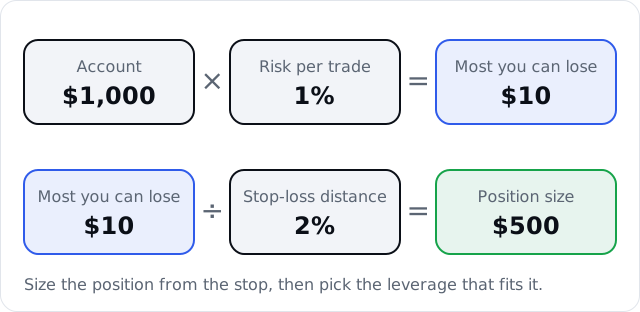
- Account: $5,000. Risk at 1%: $50.
- Entry: long Bitcoin at $60,000. Stop: $58,800, 2% below.
- Position size: $50 divided by 2% = $2,500.
- Leverage: $500 of margin at 5x, or $250 at 10x. Leverage changes the margin locked up, not the $50 at risk.
- Check: at 5x, liquidation is roughly 19% below entry, far beyond the 2% stop.
Where should you place a stop loss?
Place stops where the market proves your idea wrong, such as just below a recent low for a long, with room for normal swings, rather than at a random percentage.
Set the stop as an order when you open the trade, reduce-only so it can only close the position. Never move it further away once the trade turns against you: that is how a planned 1% loss becomes 10%. Futures order types explains stop-market, stop-limit and trailing stops.
How much leverage is sensible?
If you size from your stop, you need far less leverage than exchanges offer: 1x to 3x is a sensible range while learning. Before each order, check that the estimated liquidation price sits well beyond your stop, and cut the leverage if it doesn't. How leverage works shows how fast that gap shrinks.
What does a simple risk checklist look like?
- Know where the trade is wrong before you enter.
- Risk a small, fixed share of your account, such as 1%.
- Size the position from that risk and the stop distance.
- Use the lowest leverage that fits, and isolated margin.
- Place the stop as a reduce-only order.
- Count fees and funding in the target and the loss.
- Log every trade, set a daily loss limit, and review weekly. Common futures trading mistakes shows what to watch for.
How do fees change your break-even?
Fees put every trade slightly behind from the start. With an illustrative 0.05% taker fee on opening and on closing, the price must move 0.1% your way just to break even. On the $2,500 example that is $2.50, win or lose, so a stopped-out trade costs about $52.50, not $50. Funding on positions held across settlements comes on top, separately.
Limit orders that rest in the book usually pay the lower maker fee. Cashback cuts the rest: Commsback sends 40% of your trading fees back, so $300 of fees a month means about 40% of $300 back, and every trade needs a little less to break even. On Bybit it is paid daily in USDT, you share only your UID, and it is free. It doesn't make a losing strategy profitable. See yours on the calculator, then Get started.
Questions people ask
What is the 1% rule in trading?
A rule of thumb to risk no more than 1% of your account on a single trade, meaning the loss if your stop is hit. Some traders use 2%. It helps you survive losing runs; it promises nothing about results.
Does lower leverage mean lower risk?
It moves the liquidation price further away, which helps. But your loss is set by position size and where you exit, so a large position at low leverage can still lose a lot.
Should I always use a stop loss in futures?
Yes. Without one, liquidation becomes your exit, the most expensive way out. Use isolated margin as a second line of defence.