Crypto futures order types explained

Main takeaways
- Market orders fill at once and pay the taker fee; limit orders that rest in the book usually pay the lower maker fee.
- Post-only makes sure a limit order enters the book as a maker, or cancels it.
- Stop-market exits almost always fill but can slip; stop-limit exits control the price but may not fill.
- Use reduce-only on exit orders so they can never open a new position.
On this page
Futures exchanges offer market and limit orders, plus conditional orders that wait for a trigger price: stops, take-profits and trailing stops. Your choice also sets your fee: orders that fill at once pay the taker rate, orders that rest in the book usually pay the lower maker rate. If futures are new to you, start with what crypto futures trading is.
What is the difference between market and limit orders?
A market order buys or sells straight away at the best prices in the order book. It will fill, but in a fast market or a thin contract a large order can eat through several price levels. That cost is called slippage.
A limit order sets the worst price you will accept. If the market never reaches it, it never fills. You get price control at the cost of certainty, and a resting limit order adds liquidity to the book.
How do stop, take-profit and stop-loss orders work?
A stop waits for a trigger price, then sends an order. A stop-market sends a market order: you get out, but in a sharp move the fill can be well past the trigger. A stop-limit sends a limit order: you control the price, but if the market gaps past it you may stay in a losing position.
A stop-loss closes your position when the price moves against you; a take-profit closes it at your target. For protective stops, many traders accept some slippage over the risk of no exit. Most exchanges let you trigger on the last price or the mark price: see perpetual futures explained.
What do post-only, reduce-only and trailing stops do?
- Post-only: a limit order that only ever enters the book as a maker. If it would fill at once, the exchange cancels it instead of charging the taker fee.
- Reduce-only: the order can only shrink or close a position, never open a new one or flip you to the other side. Use it on every exit.
- Trailing stop: a stop that follows the price at a set distance as it moves your way. It locks in part of a gain, but choppy markets can close you out early.
- Time in force: good till cancelled, immediate or cancel, and fill or kill decide how long an order stays live.
Which order type should you use?
Names and behaviour vary by exchange, so read the order form's help text and test an unfamiliar type with a tiny position first.
| Order | Best for | Usually pays |
|---|---|---|
| Market | Getting in or out at once | Taker fee |
| Limit | Entering or exiting at a set price | Maker fee if it rests |
| Post-only limit | Making sure you pay the maker fee | Maker fee, or cancelled |
| Stop-market | Exits that must fill | Taker fee |
| Stop-limit | Exits with a price limit | Depends on the fill |
| Trailing stop | Following a trend | Taker fee |
How do order types change your fees?
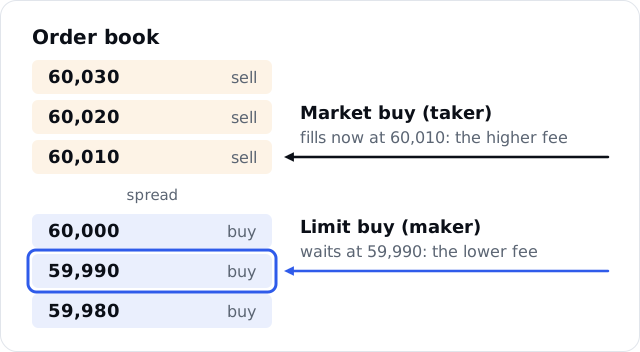
An order that fills against the book takes liquidity and pays the taker fee. One that rests until someone trades against it makes liquidity and usually pays the lower maker fee. A limit order priced to cross the spread fills at once, so it pays the taker fee too.
With illustrative rates of 0.02% maker and 0.05% taker, a $10,000 round trip costs $4 as a maker and $10 as a taker. Over 100 round trips a month, that is $400 against $1,000. Planned entries placed as post-only orders save the difference; a stop loss is still worth its taker fee. How trading fees work has the details.
How can you pay less on every order?
Whatever mix you end up with, Commsback sends 40% of those fees back, maker and taker alike: $1,000 of fees in a month means about 40% of $1,000 back. On Bybit it is paid daily in USDT, you share only your UID, it is free, and you keep Bybit's sign-up rewards. It lowers costs; it doesn't make losing trades profitable. Get started.
Questions people ask
Will a stop-loss order always close my position at my price?
No. A stop-market triggers at your level but fills at the next available prices, which can be worse in a fast market. A stop-limit controls the price but may not fill at all.
Why was my post-only order cancelled?
Because it would have filled at once as a taker. Post-only orders are cancelled, or repriced on some exchanges, rather than paying the taker fee.
Should I use last price or mark price for stops?
Mark price triggers are less likely to fire on a brief spike on one exchange; last price triggers follow the trades on your chart. Many traders use mark price for stop losses. More in futures risk management.