Perpetual futures explained: funding rates and mark price

Main takeaways
- Perpetual futures have no expiry date, so you can hold a position for as long as your margin supports it.
- A funding rate keeps the price near spot: when it is positive, longs pay shorts; when negative, shorts pay longs.
- Exchanges use a mark price, built from several spot markets, to value positions and decide liquidations.
- Funding passes between traders, while trading fees go to the exchange on every open and close.
On this page
A perpetual future is a crypto futures contract with no expiry date. A funding rate, paid between longs and shorts every few hours, keeps its price close to the coin's spot price.
What is a perpetual futures contract?
Dated futures expire, so traders who want to stay in a position must close it and open the next contract. A perpetual removes the expiry: a Bitcoin perpetual tracks Bitcoin for as long as you hold it.
With no settlement date pulling its price back to spot, a perpetual uses funding payments to stay close to it. If you are new to futures, start with what is crypto futures trading.
How does the funding rate work?
Funding is a payment between traders; on the major exchanges the exchange doesn't keep it. A positive rate means the perpetual trades above spot, so longs pay shorts. That makes longs less attractive and pulls the price back down. A negative rate works the other way.
You pay or receive your position value times the rate, and only if you hold a position at the settlement time. Many contracts settle every 8 hours, some every 4 hours or every hour, and the schedule varies by exchange and contract.
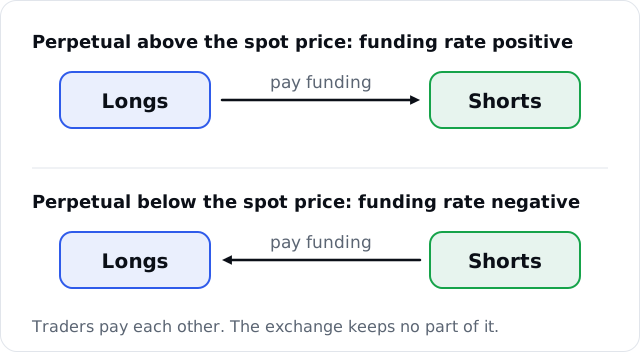
| Funding rate | Usually means | Longs | Shorts |
|---|---|---|---|
| Positive | Perpetual above spot | Pay | Receive |
| Negative | Perpetual below spot | Receive | Pay |
| Near zero | Perpetual close to spot | Little | Little |
How much does funding cost?
Take an illustrative rate of 0.01% every 8 hours on a $10,000 long: $1 per settlement, $3 a day, about $90 over 30 days if the rate held. A short of the same size would receive those amounts.
Rates move, and in strong rallies they climb far higher. For a trade of a few hours funding is often tiny; for a position held for weeks it can be the biggest cost. Margin, liquidation and funding shows how it affects your margin.
What is the difference between mark price and last price?
Exchanges track three prices for each contract, and liquidation uses the mark price, not the last trade. So a brief spike on one order book shouldn't liquidate you on its own.
- Last price: the most recent trade on that exchange's contract. One large order can spike it for a few seconds.
- Index price: an average of the coin's spot price across several major exchanges.
- Mark price: a fair-value price built from the index, used for unrealised profit and loss and for liquidation.
- Many exchanges let stop orders trigger on the last or the mark price: see futures order types.
Why are perpetuals the most traded crypto contract?
- No rollover: one contract per coin, held as long as you like.
- Liquidity: everyone trades the same contract, so order books are deep on the main coins.
- Simplicity: the price stays close to spot, so the chart looks like the coin's chart.
- Shorting and hedging: going short is as easy as going long.
What do perpetuals cost, and how do you pay less?
Perpetuals have two separate costs. Funding passes between traders and depends on the market. Trading fees go to the exchange: you pay them to open and to close, on the full position size, at the maker or taker rate. How trading fees work explains the difference.
For active traders, fees are the larger and steadier cost. With an illustrative 0.05% taker fee, ten round trips a day on a $5,000 position cost about $50 a day, before any funding.
Commsback sends 40% of those trading fees back. On Bybit it is paid daily in USDT, you share only your UID, it is free, and you keep Bybit's own sign-up rewards. Funding isn't a fee, so it isn't included, and cashback doesn't make a losing trade profitable. Get started.
Questions people ask
Who pays funding on perpetual futures?
When the rate is positive, longs pay shorts. When it is negative, shorts pay longs. On the major exchanges the payment passes between traders rather than going to the exchange.
Do I pay funding if I close before the funding time?
No. Funding applies only to positions open at the settlement moment. A position opened and closed between two settlements pays no funding, though it still pays trading fees.
How often is funding paid?
Every 8 hours is common, but some contracts settle every 4 hours or every hour, and intervals can change in volatile markets. Check the contract details on your exchange.