How leverage works in crypto futures

Main takeaways
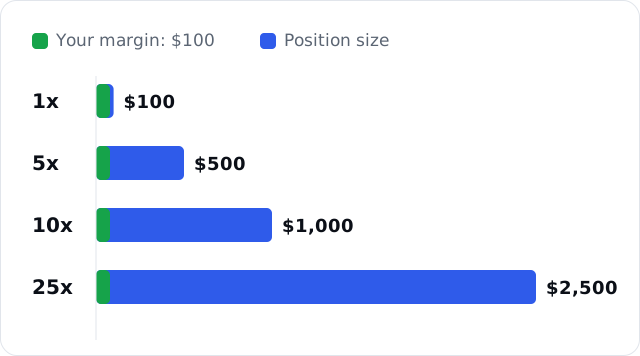
- Leverage is position size divided by margin: at 10x, $100 controls a $1,000 position.
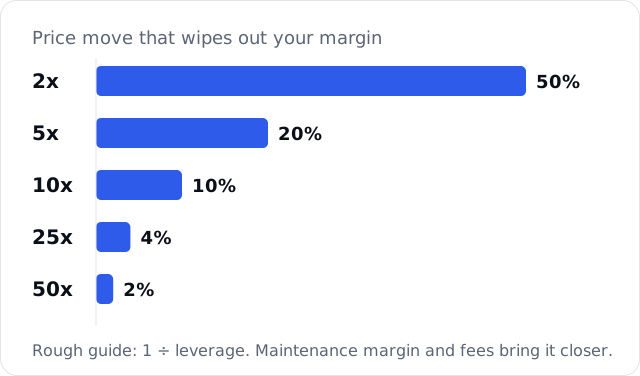
- A price move of roughly 1 divided by your leverage wipes out the margin: about 10% at 10x, 2% at 50x.
- Fees are charged on the full position, so higher leverage makes each round trip a bigger share of your margin.
- Size the position from what you are willing to lose, then use the lowest leverage that fits.
On this page
Leverage lets you open a futures position larger than your margin: at 10x, $100 controls $1,000, so every 1% price move changes your margin by about 10%. It also pulls your liquidation price closer and makes fees larger relative to your margin. If futures are new to you, start with what crypto futures trading is.
What does leverage mean in crypto trading?
Leverage is the ratio between your position size (the full value of the contract) and the margin backing it. Exchanges let you set it per contract, up to a maximum far higher than most traders should use.
Keep the margin at $100 and raise the leverage, and both the position and your exposure grow:
| Leverage | Position on $100 | A 1% move changes margin by | Margin gone after a move of about |
|---|---|---|---|
| 2x | $200 | 2% | 50% |
| 5x | $500 | 5% | 20% |
| 10x | $1,000 | 10% | 10% |
| 25x | $2,500 | 25% | 4% |
| 50x | $5,000 | 50% | 2% |
How does leverage move your liquidation price?
A position is liquidated when losses bring its margin down to the maintenance margin, a small buffer the exchange requires. Because that buffer is taken off first, the real liquidation price sits a little closer than the table suggests.
Example: a long on Bitcoin at $60,000 with 10x isolated margin. A 10% fall would reach $54,000, but the position is liquidated slightly above that. At 50x, a fall of under 2% is enough, which Bitcoin can do in minutes. The exchange shows the estimated liquidation price before you confirm: read it every time. Margin, liquidation and funding explains the mechanics.
Does higher leverage mean higher risk?
Your profit or loss depends on the position size. A $1,000 position at 2x and at 10x gains or loses exactly the same dollars; the difference is whether $500 or $100 backs it, and so how far the price can move before liquidation.
Leverage is risky because it tempts you into positions too large for your account and puts liquidation within ordinary swings. Choose the position size first, from how much you are willing to lose, then use only the leverage it needs: futures risk management shows the calculation.
How much leverage should a beginner use?
- As little as possible: 1x to 3x is a sensible range to learn in.
- Never pick leverage because the slider allows it.
- Check the liquidation price before every order and keep your stop loss well before it.
- Prefer isolated margin while you learn: see isolated vs cross margin.
Why does leverage multiply your fees?
Fees are a percentage of the position, not your margin. Take an illustrative 0.05% taker fee on opening and on closing, 0.1% of the position per round trip. On $100 of margin that is $1 at 10x (1% of your margin), $2.50 at 25x and $5 at 50x, before the price has moved at all. Funding is also charged on the full position, separately from fees.
The table shows what opening and closing a $10,000 position costs at each partner exchange's standard taker rate.
| Exchange | Futures taker fee | Open and close $10,000 |
|---|---|---|
| Bybit | 0.055% | $11.00 |
| Binance | 0.05% | $10.00 |
| OKX | 0.05% | $10.00 |
| BloFin | 0.06% | $12.00 |
| Bitget | 0.06% | $12.00 |
With Commsback on Bybit, 40% of those fees come back to you, so that round trip costs about $6.60 after cashback.
How can you pay less on leveraged trades?
Use limit orders where you can, since resting orders usually pay the lower maker fee, and trade less often. Then get part of what you still pay back.
Because cashback is a share of your fees, it grows with them too. Commsback sends 40% of your trading fees back: $500 of fees a month means about 40% of $500 back. On Bybit it is paid daily in USDT, you share only your UID, it is free, and you keep Bybit's sign-up rewards. It lowers costs; it doesn't make a losing trade profitable. Get started or estimate yours on the calculator.
Questions people ask
What does 10x leverage mean?
Your position is ten times the margin you put down. With $100 of margin you control $1,000, so a 1% price move changes your margin by about $10, or 10%.
Does leverage change the fee rate?
No. The rate stays the same, but it applies to the full position size, so higher leverage on the same margin means more fees. Rates are in our exchange fee comparison.
Can leverage make me lose more than my margin?
On isolated margin at major exchanges, a liquidated position normally loses its margin and no more. With cross margin your whole available balance backs your positions, so losses can reach much further.